
In terms of efficiency: One person welds for one day, while a robot welds for half a day
When performing hand welding, even the most proficient expert must take a rest. After welding for a bit, my eyes, arms and waist all hurt. The five is merely five hours. Robots are not like that. It is powered on 24. A single automobile door can be welded in 15 minutes by hand and 3 minutes by robot, a 400% gain in efficiency. A robot can weld 35 to 40 weld sites in an hour, but a person can only weld 12 to 15.
Quality comparison: Humans look at the status, while robots look at the program
The state of the master on that particular day determines whether or not hand welding is good. The weld seam will be different if your hand shakes, your eyes blur, or you’re feeling a little weird. Even if the quality may be steady, weld, weld, weld, weld, 9090 minutes may be stable. Once the program is built for robot welding, the first piece will be identical to the thousandth piece. The quality much beyond the manual norm, and the weld formation is consistent and lovely.Robotic welding has a certification rate of over 98%, compared to about 85% for human welding.
Cost comparison: Spend a little more in the early stage, but keep saving later
A robot, once purchased, can operate for five to eight years, requiring nothing beyond electricity and routine maintenance. Over the last three years, robotic labor has cost only one-third as much as manual welding, and wire consumption has been cut by more than 15%. Some companies report that installing welding robots has reduced their labor costs by 40%. In 2025, a company in Jiangsu replaced 13 welders with robots, eliminating 345 manual shifts. Another steel structure firm saw its total labor costs fall by 80% after going robotic. Though the initial investment is higher, it is fully recovered in the years that follow — and then some.
In terms of stability: One gets more and more tired as it is welded, while the other becomes more and more stable
Manual welding was steady in the morning, but by afternoon the welder’s hand began to tremble. After welding into the night, he could barely lift his arms — so how could the weld seam stay consistent? Robots never face this problem. Their accuracy is held to ±0.02 millimeters, with welding torch positioning error within ±0.05 millimeters, compressing weld error from a manual 3 millimeters down to under 0.2 millimeters. As one workshop director put it: “Manual welding is ‘about right’; robot welding is ‘must be precise.’”But does this mean robots have fully replaced humans? Not yet. In complex working conditions, non-standard structures, and small-batch customization, the experience and adaptability of seasoned masters remain out of reach for robots for now. Robots also cannot correct their own errors — once a fault occurs, they keep repeating it and need human supervision. The most reliable model today is human-machine cooperation: people handle workpiece arrangement, system monitoring, and anomaly response, while robots do the welding. After adopting this approach, some agricultural machinery factories raised average daily output per person from 45 pieces to 78 pieces.
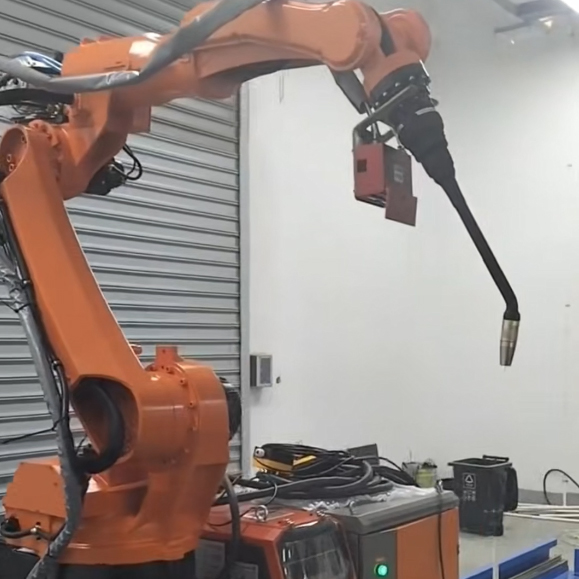
The difference between manual and robotic welding is clear at a glance: robots are two to three times more efficient, deliver far more consistent quality, cost less over the long run, and remove the worry of finding qualified welders at all. If your workshop’s work involves repetitive welding, large batches, and high quality demands, the numbers are worth calculating. The Ares welding robot requires an investment of around 100,000 yuan, offers ±0.05 mm accuracy, and supports three solutions — laser tracking, arc tracking, and contact positioning. It can be mastered after just half a day of training. Want to see a comparison video? Visit Ares Workshop, and we’ll demonstrate the welding on the spot.
Post time: Sep-30-2026


